
Samara Morphology
Maple fruits are schizocarpic, splitting at maturity into two one-seeded mericarps. Each mericarp consists of a rounded seed chamber (the nutlet) and an elongated membranous wing. The wing generates autorotation during descent, slowing the fall rate and enabling wind-assisted dispersal over distances that, under appropriate wind conditions, can substantially exceed the crown radius of the parent tree.
The angle formed between the two mericarps of a samara pair is one of the most practically useful identification characters outside the leaf season. It differs distinctly among the three species and is measurable with a simple protractor on fresh or dried material.
Acer platanoides Samaras
Norway Maple Samara
Acer platanoides L.- Wing angle
- Wide, approaching 180° (nearly flat)
- Wing length
- Typically 35–45 mm
- Nutlet
- Strongly flattened, disc-like
- Dispersal season
- September–October
- Colour at maturity
- Pale straw to buff
The near-flat wing angle of A. platanoides samaras is immediately recognisable and distinguishes them from both other species. The nutlet is notably flat, almost disc-shaped, and the wings are relatively broad in proportion to their length. This wide-angle geometry generates a slower, more stable autorotation compared to the narrower-angled samaras of sycamore, and dispersal is primarily driven by autumn wind events as leaves are dropping.
Dispersal note: The near-horizontal wing angle creates a wider rotor diameter, which, in studies of Acer autorotation dynamics, corresponds to reduced terminal velocity — an adaptation to open or edge habitats where lateral wind exposure is greater.
Acer pseudoplatanus Samaras
Sycamore Samara
Acer pseudoplatanus L.- Wing angle
- Acute to right angle (60–90°)
- Wing length
- Typically 30–40 mm
- Nutlet
- Distinctly rounded, not flattened
- Dispersal season
- September–November
- Colour at maturity
- Green turning brown
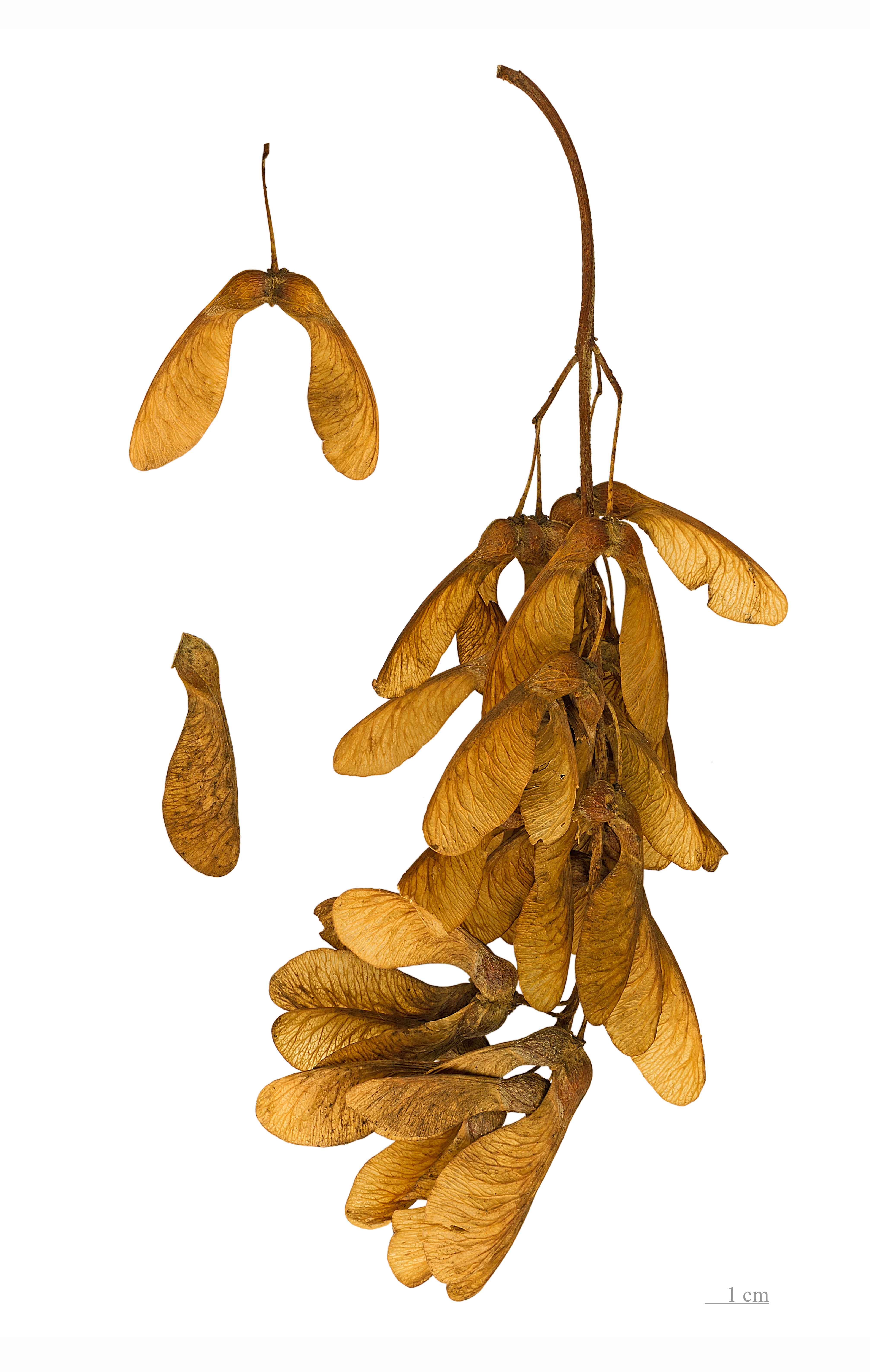
Sycamore samaras have an acute to right-angle geometry between the two wings. The nutlet is rounded and noticeably more three-dimensional than in Norway maple. The wings themselves are slightly narrower relative to their length, and they retain a green colour well into autumn before turning brown at full maturity. In upland forests of the Tatry and Bieszczady foothills, sycamore disperses seeds over a prolonged period, benefiting from the increased wind exposure typical of montane forest edges.
Acer campestre Samaras
Field Maple Samara
Acer campestre L.- Wing angle
- Nearly horizontal (160–180°), wings in one plane
- Wing length
- Typically 20–30 mm
- Nutlet
- Slightly hairy when young
- Dispersal season
- August–October
- Colour at maturity
- Pale buff to reddish-brown
Field maple samaras resemble those of Norway maple in their near-horizontal wing angle but are distinctly smaller overall, with wing lengths rarely exceeding 30 mm in Central European populations. The pair of wings lies in a single plane when fully open. The earlier dispersal season — beginning as early as late August — is consistent with the species' ecological preference for drier, often more exposed habitats at forest margins and hedgerows across the Polish lowlands.

Ecological Context of Dispersal
All three species are wind-dispersed (anemochorous). Their dispersal distances depend on wind speed, release height, and the aerodynamic properties of each samara type. In closed-canopy stands, most seeds land within the crown projection; in open or edge conditions, dispersal distances increase substantially. This has direct implications for natural regeneration patterns observed in post-disturbance forest gaps and along forest tracks.
In Poland, spontaneous regeneration of A. platanoides and A. pseudoplatanus is commonly observed along forest road verges and clearings, where open air movement favours greater displacement. Field maple, with its earlier dispersal and smaller samaras, tends to colonise hedgerow systems and field margins at the agricultural-forest interface in central and eastern Poland.
Summary Comparison
| Character | A. platanoides | A. pseudoplatanus | A. campestre |
|---|---|---|---|
| Wing angle | ~180° (flat) | 60–90° (acute) | ~180° (flat) |
| Wing length | 35–45 mm | 30–40 mm | 20–30 mm |
| Nutlet shape | Flat, disc-like | Rounded | Slightly hairy |
| Dispersal peak | Oct–Nov | Sep–Nov | Aug–Oct |